
FlowPick vs. Video DownloadHelper: Which One Should You Use in 2026?
Let's get this out of the way: we built FlowPick. So read this comparison with whatever level of skepticism you think is appropriate. That said, we've done our best to be fair — Video DownloadHelper is a solid extension with 15 years of history, and there are genuinely scenarios where it's the better choice.
Here's the honest breakdown.
Background
Video DownloadHelper launched in 2007 and was one of the first browser extensions capable of detecting and downloading streaming video. For years, it was the go-to recommendation on forums and tech blogs. It has over 3 million active users and hundreds of thousands of reviews across Chrome and Firefox combined.
FlowPick launched in 2025 with a narrower focus: making HLS and DASH downloads work without requiring any extra software beyond the browser extension itself.
Core Technical Difference
This is what most people actually care about:
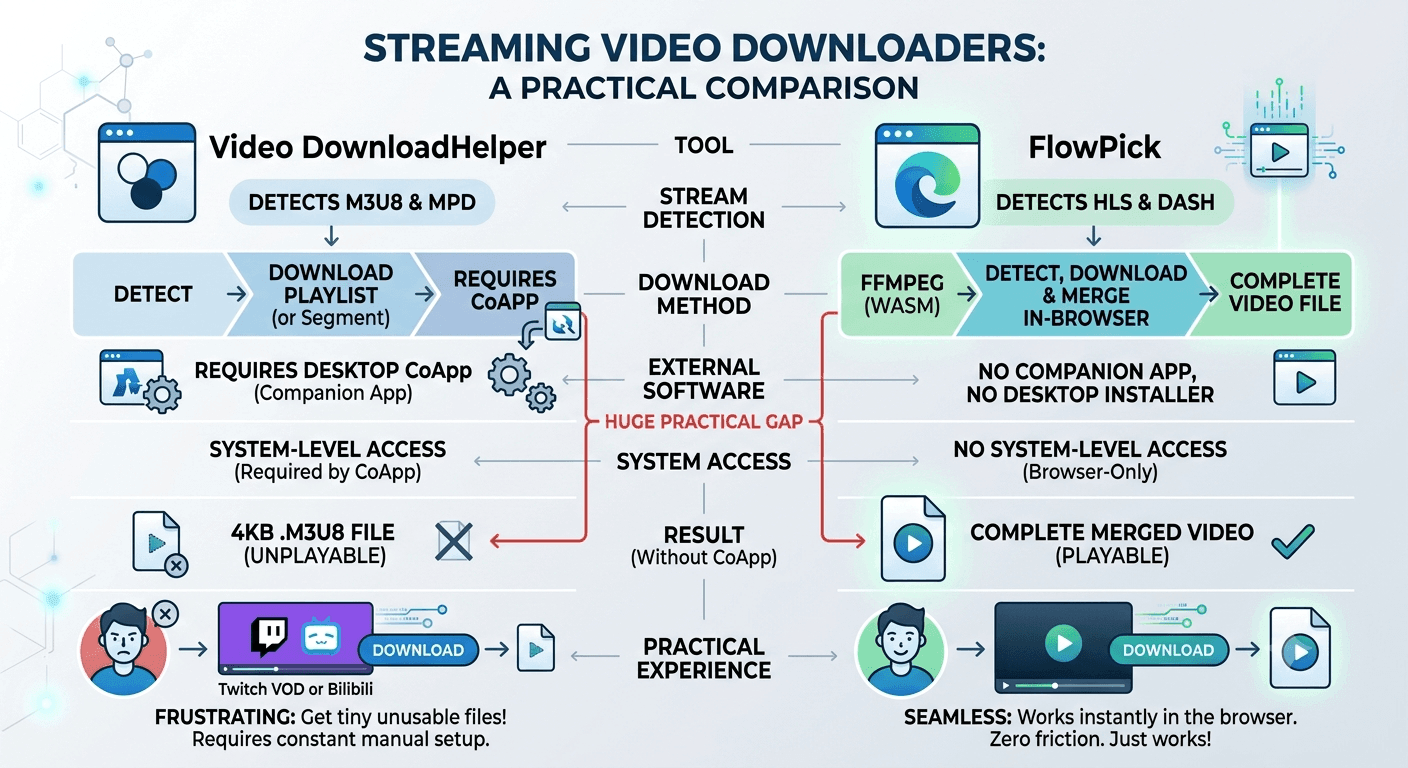
Video DownloadHelper can detect M3U8 and MPD streams, but to download and merge them, you need to install a separate CoApp (companion application) — a standalone desktop program. Without CoApp, clicking "download" on an HLS stream gives you either a playlist file or a single segment, neither of which is playable.
FlowPick uses WebAssembly-compiled FFmpeg to handle HLS and DASH entirely within the browser — no companion app, no desktop installer, no system-level access required.
This gap matters a lot in practice. If you've ever installed Video DownloadHelper, clicked download on a Twitch VOD or Bilibili video, and ended up with a 4KB .m3u8 file — that's the CoApp requirement at work.
Feature Comparison Side by Side
| Feature | FlowPick | Video DownloadHelper |
|---|---|---|
| Price | Free, no tiers | Free (limited) + CoApp €5.99 one-time |
| HLS/M3U8 download | ✅ In-browser, no extra tools | ✅ Requires CoApp |
| DASH/MPD download | ✅ In-browser, no extra tools | ⚠️ Requires CoApp |
| AES-128 decryption | ✅ Automatic | ⚠️ Partial support (CoApp handles some) |
| In-browser video merging | ✅ WebAssembly FFmpeg | ❌ Delegated to CoApp |
| Batch image download | ✅ Built-in | ❌ Not available |
| Analytics tracking | ❌ None | ✅ Free version has it |
| Open source | ✅ Full codebase | ❌ Partially open source |
| Requires companion app | ❌ No | ✅ Yes, for HLS/DASH/merging |
| Chrome | ✅ | ✅ |
| Firefox | ✅ | ✅ |
| Edge | ✅ | ⚠️ Limited support |
| Format conversion | MP4 / TS output | CoApp supports multiple formats |
Installation Experience
FlowPick:
- Search "FlowPick" on the Chrome Web Store
- Click "Add to Chrome"
- Done
The whole thing takes 30 seconds. No account registration, no system permission prompts, no firewall dialogs.
Video DownloadHelper:
- Install the VDH extension from the store (10 seconds)
- Visit paid content, click download — get a .m3u8 file
- Search "Video DownloadHelper CoApp"
- Download the CoApp installer (varies by platform)
- Run the installer (may require admin privileges)
- Configure the CoApp path in the extension
- Restart the browser
- Try again
If everything goes smoothly, about 5-10 minutes. But users have reported CoApp breaking after major browser updates, requiring reconfiguration and re-authorization.
Privacy and Permissions
The two extensions request noticeably different permissions:
FlowPick requests:
webRequest— monitor network requests (for media detection)storage— save settingsdownloads— write downloaded files- Page content access (current tab)
Video DownloadHelper requests:
- Similar base permissions as above
- Plus: native messaging permission to communicate with the local CoApp
- CoApp runs at the system level with full filesystem access
FlowPick is fully open source — the code is auditable. VDH's extension is partially open source; CoApp is not.
On data collection: VDH's free version has usage analytics (can be disabled in settings), and CoApp makes external connections for license verification. FlowPick has no telemetry, no license server.
Where Video DownloadHelper Wins
Format conversion options: with CoApp installed, VDH can convert to AVI, MKV, WebM, MP3, and more. FlowPick currently outputs MP4 and TS — pick MP4 for maximum compatibility, or TS for the fastest possible direct concatenation. If you need MKV or codec-level conversion, FlowPick doesn't do that.
Mature ecosystem: 15 years of bug reports and edge cases means VDH handles a wider range of obscure sites and player implementations. FlowPick is newer.
Format negotiation: VDH's CoApp talks directly to FFmpeg on your system, using whatever codecs you have installed. FlowPick's WebAssembly FFmpeg is more constrained.
Firefox power users: VDH has always had a strong Firefox presence. FlowPick is available on Firefox, but in-browser merging is better optimized for Chrome's File System Access API.
Where FlowPick Wins
Zero-friction installation: one click on the Chrome Web Store. Done. No companion app, no system-level installer, no firewall permissions.
HLS/DASH without extra tools: this is the big one. With VDH's free version, downloading a Bilibili video or Udemy course gives you unplayable files. With FlowPick, you get a playable MP4 immediately — no extra steps.
Privacy: zero analytics tracking, no license server heartbeats, fully auditable extension. VDH's free version has usage analytics, and CoApp makes external connections.
Cost: completely free. VDH's free version limits streaming content; full HLS/DASH functionality requires the CoApp purchase.
Batch image downloading: FlowPick has a built-in image downloader that can detect and download images in bulk across any website. VDH has no equivalent feature. If you frequently need to batch-download images, this is a significant plus.
Large file handling: FlowPick uses the File System Access API for streaming writes, with theoretically no file size limit. Even 4K feature-length videos won't crash from memory exhaustion.
Pricing Breakdown
Video DownloadHelper:
- Free version: works for simple MP4/WebM downloads. HLS/DASH requires CoApp.
- CoApp: €5.99 one-time (single browser), subscription options for multiple browsers/devices
- Some users report CoApp license breaking after major browser updates
FlowPick:
- Permanently free, no pro tier, no limits on download count, thread count, or file size.
Real-World Test Cases
We tested both extensions against a set of common use cases. Here's what actually happened (not what the marketing pages say):
Bilibili 1080P DASH video
- FlowPick: detected, merged, completed as MP4 in about 3 minutes
- VDH (free, no CoApp): downloaded a playlist file, unplayable
- VDH (with CoApp): succeeded, similar download time
Twitch VOD (HLS/M3U8)
- FlowPick: detected M3U8, merged, saved as MP4
- VDH (with CoApp): also succeeded
Udemy course (AES-128 encrypted HLS)
- FlowPick: detected, decrypted segments, merged as MP4
- VDH (free): decryption failed
- VDH (with CoApp): results varied by CoApp version
Pinterest image gallery (batch)
- FlowPick: detected 47 images, batch-downloaded in 8 seconds
- VDH: no batch image feature
4K large file video (~3.2 GB)
- FlowPick: streaming write via FSA, stable memory throughout, completed
- VDH (with CoApp): relies on system FFmpeg, needs sufficient local disk temp space
Which One Should You Install?
Install FlowPick if:
- You mainly encounter HLS or DASH streams (Bilibili, Twitch, Udemy, course platforms)
- You don't want to install desktop software
- You care about privacy and open source
- You want batch image downloading
- You don't want to pay
Install Video DownloadHelper if:
- You need specific format conversions (MKV, AVI, MP3, etc. — not just MP4 or TS)
- You're already using CoApp and it works for you
- You primarily use Firefox
- You need to handle obscure players that newer tools haven't caught up with yet
Install both: they don't conflict. Some power users run both and use whichever detects better on a given site.
Recommended Reading
- How FlowPick Merges Video Segments into MP4 in the Browser — the technical implementation behind "no CoApp needed," breaking down the full in-browser merging pipeline
- How to Download Bilibili Videos to Your Computer — Bilibili is a DASH-heavy platform; the CoApp gap is most visible here