
Online Tools
In addition to the browser extension, FlowPick provides two independent online tool pages that allow downloading streaming media without installing any software. These tools share the same download engine as the extension but run in a web environment.
When to Use Online Tools
Online tools are a supplementary solution to the extension, suitable for following scenarios:
| Scenario | Recommended Method | Reason |
|---|---|---|
| Download anytime during daily browsing | Browser Extension | Auto-detection, one-click download |
| Already have stream URL, just want quick download | Online tools | No installation needed, open and use |
| Environments where extensions cannot be installed (company computers, public devices) | Online tools | Pure web page, no installation required |
| Need to batch download multiple known URLs | Online tools + Batch Download | Paste one by one, queue management |
| Encounter CORS restrictions | Browser Extension | Extension permissions can bypass same-origin policy |
Differences from Extension
| Feature | Browser Extension | Online Tools |
|---|---|---|
| Auto-detect media | Supported, auto-sniffs on page load | Not supported, requires manual paste of URL |
| Installation requirement | Requires extension installation | No installation needed, just open webpage |
| Cross-origin restrictions | Extension permissions can bypass some restrictions | Subject to browser same-origin policy |
| Download engine | Same | Same |
| Save directory selection | Supported | Supported |
| Use case | Anytime download during daily browsing | Quick download when stream URL already available |
useStreamMerge), with identical download speed, merge logic, and encryption/decryption capabilities. The only difference is in media detection method.M3U8/HLS Stream Downloader
Access path: /m3u8-downloader
Overview
M3U8 downloader specifically handles HLS (HTTP Live Streaming) streaming protocol. Supports both Master Playlist and Media Playlist manifest formats.
For detailed principles of HLS protocol (Master Playlist vs Media Playlist, segment structure, encryption mechanism), see Video Sniffing — HLS Streams.
Usage Flow
- Get M3U8 URL: Obtain
.m3u8address from browser developer tools (Network panel) or third-party tools - Paste URL: Paste address into input field, tool will automatically parse manifest
- Select quality: If Master Playlist, select target resolution from quality list
- Configure parameters: Set concurrent thread count, output format, and filename
- Start download: Click download button, tool will automatically download all segments and merge
Supported Manifest Types
Master Playlist (Multi-bitrate)
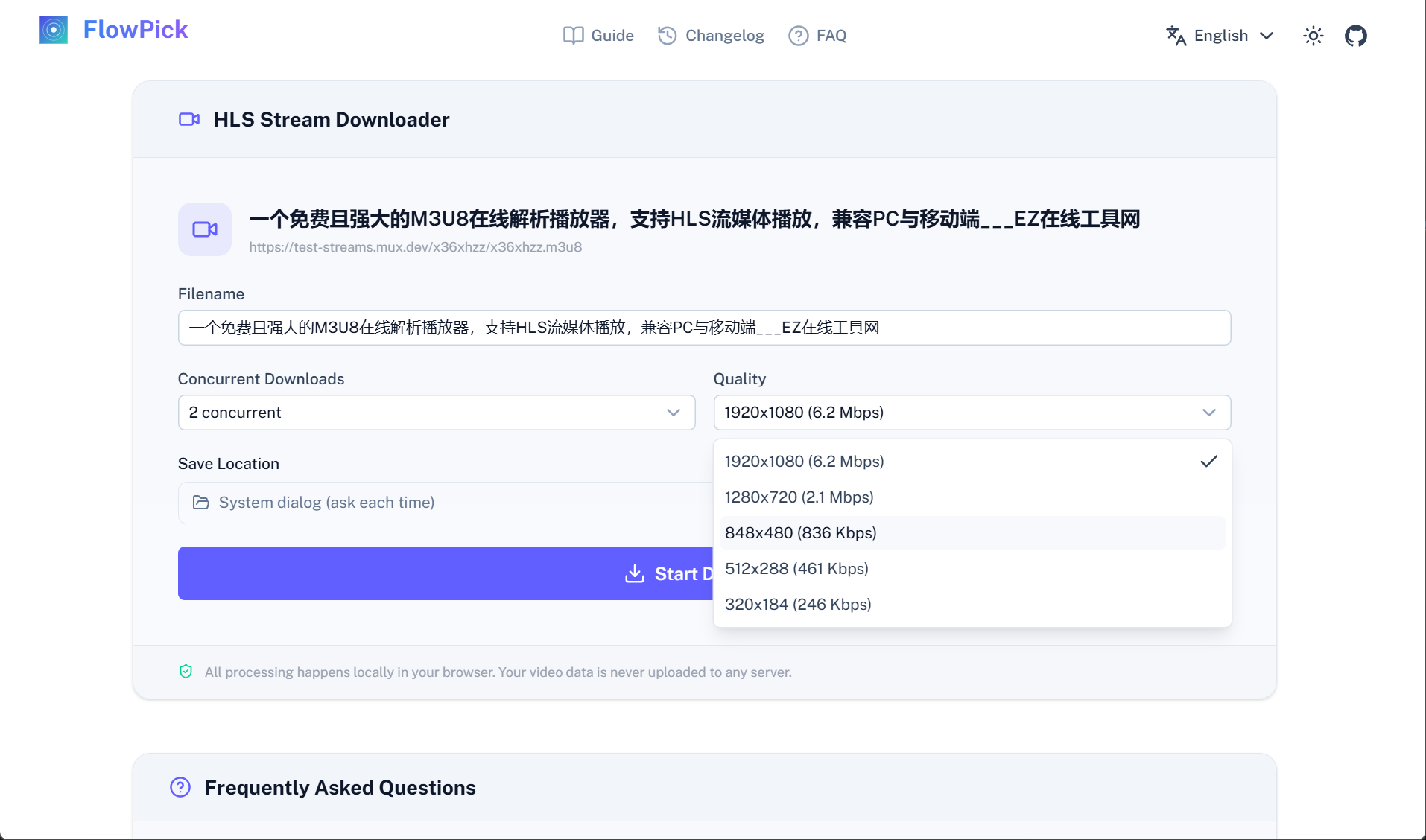
Contains multiple sub-streams of different qualities. After parsing, displays quality selector:
1080p · 5.2 Mbps · avc1.640028
720p · 2.8 Mbps · avc1.64001f
480p · 1.2 Mbps · avc1.64001e
After selecting a quality, tool will download corresponding Media Playlist and get segment list.
Media Playlist (Single-bitrate)
Directly contains TS segment list, no need to select quality. After parsing, directly displays segment count and estimated size.
Encryption Support
M3U8 downloader supports following encryption methods:
| Encryption Method | Support Status | Description |
|---|---|---|
| AES-128 CBC | Fully supported | Auto-obtains key and decrypts segments |
| SAMPLE-AES | Not supported | Requires dedicated decoder |
| Clear Key | Not supported | DRM protected content |
| Widevine / PlayReady | Not supported | Commercial DRM, cannot decrypt |
For AES-128 encrypted streams, tool will:
- Parse
#EXT-X-KEYtag to get key URI - Download key file
- Use Web Crypto API (
crypto.subtle.decrypt) to decrypt each segment in browser - Merge decrypted segments into final file
Segment Download & Merge
Download process is divided into three phases:
Phase 1: Parsing (0% ~ 5%)
- Download and parse M3U8 manifest
- Extract segment URI list
- Sample estimate total size
Phase 2: Download (5% ~ 85%)
- Multi-threaded concurrent segment download
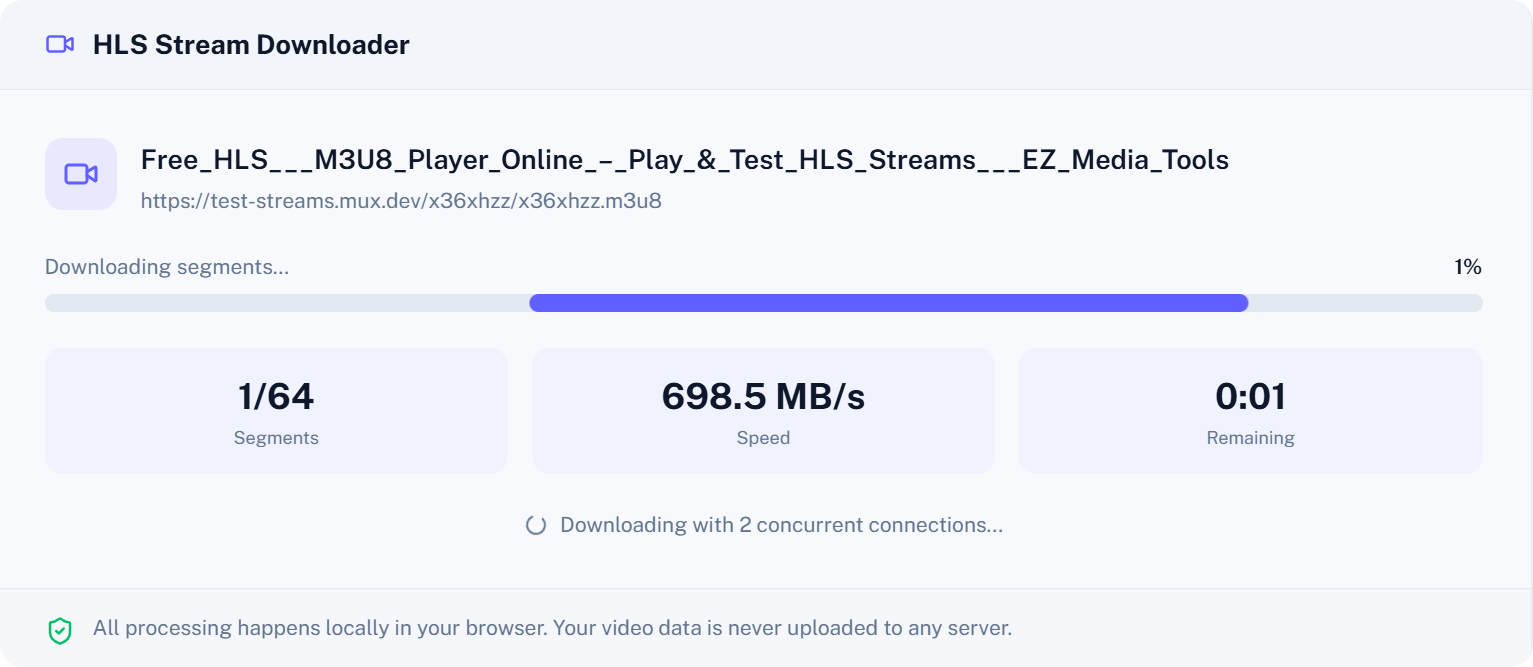
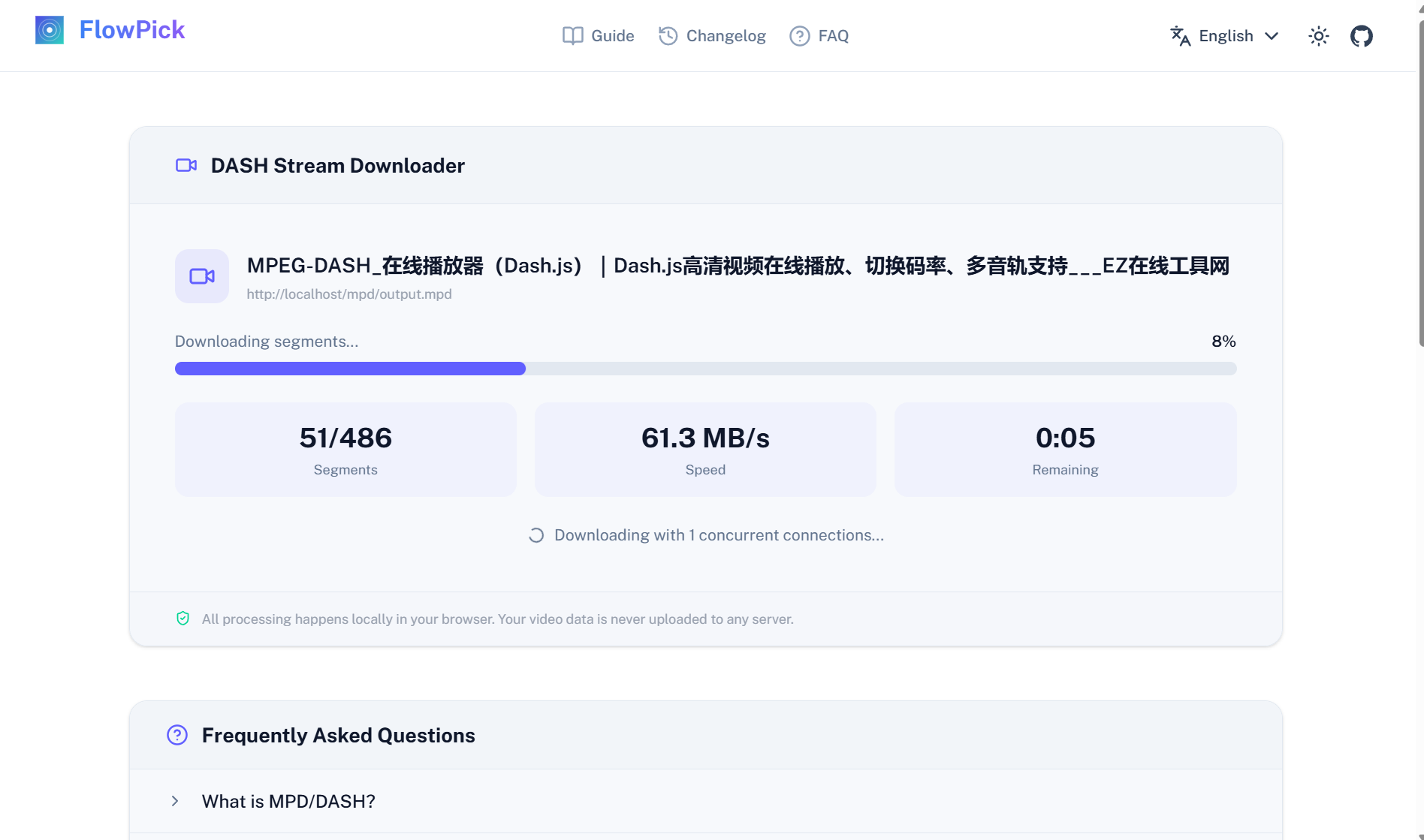
- Real-time display of progress, speed, and estimated remaining time
- Auto-retry failed segments (up to 3 times, exponential backoff)
Phase 3: Merge (85% ~ 100%)
- Concatenate segments in order
- For TS format: Direct binary concatenation (fastest)
- For MP4 output: Use FFmpeg WASM for container conversion
Progress Information
Real-time display during download:
| Metric | Description |
|---|---|
| Progress percentage | Completed segments / Total segments |
| Download speed | Real-time speed estimate based on sliding window |
| Estimated remaining time | Calculated based on current speed and remaining segments |
| Downloaded bytes | Cumulative downloaded data volume |
MPD/DASH Stream Downloader
Access path: /dash-downloader
Overview
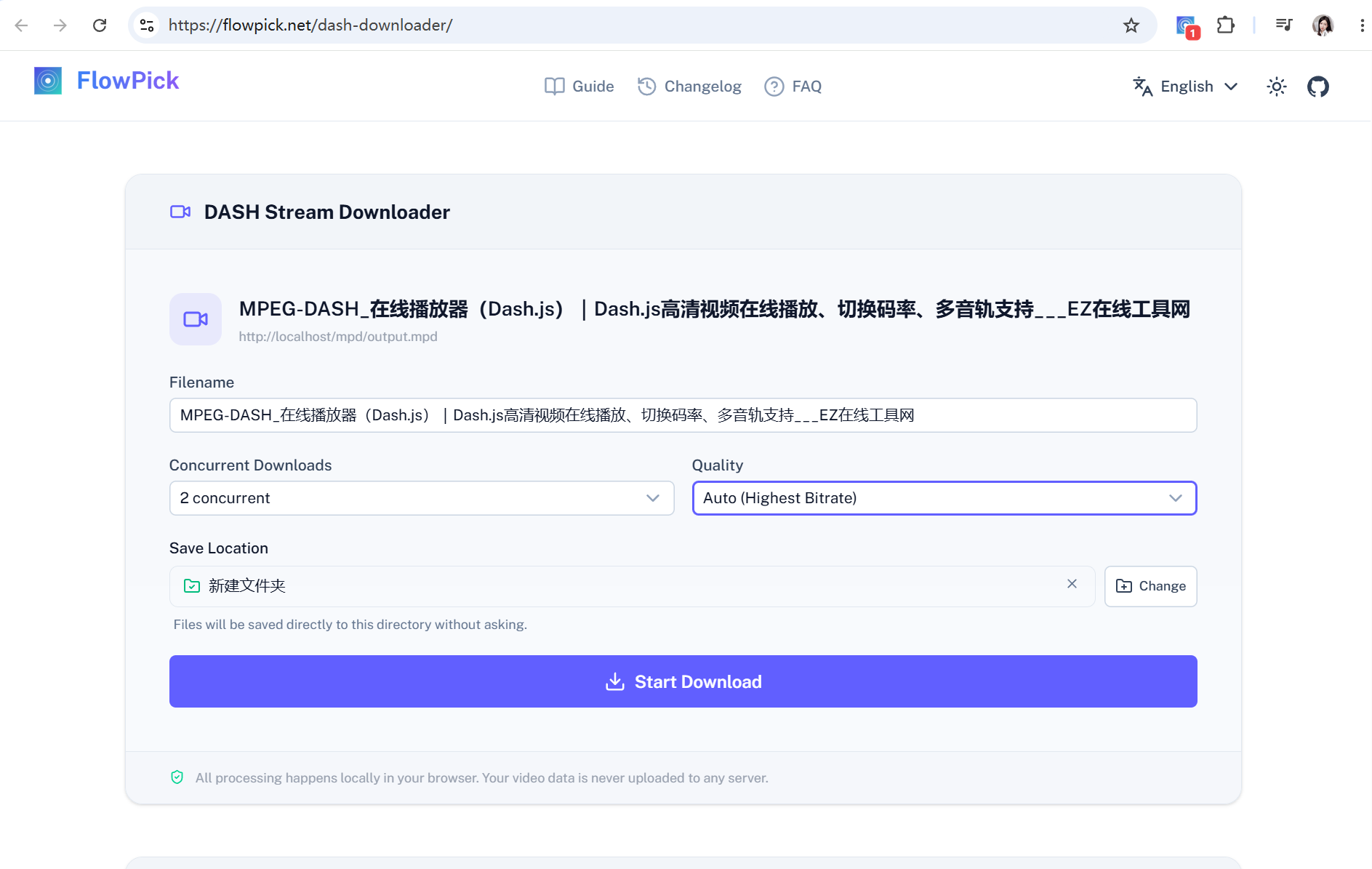
DASH downloader handles MPEG-DASH streaming protocol. Unlike HLS, DASH streams' video and audio are usually separated and need to be downloaded separately then merged.
For detailed principles of DASH protocol (MPD structure, audio-video separation, FMP4 packaging), see Video Sniffing — DASH Streams.
Usage Flow
- Get MPD URL: Obtain
.mpdaddress from browser developer tools - Paste URL: Paste address into input field
- Select quality: Select from parsed video stream list
- Configure parameters: Set concurrent thread count and filename
- Start download: Tool automatically downloads video and audio segments and merges them
MPD Manifest Parsing
DASH downloader uses mpd-parser library to parse MPD manifest, extracting following information:
- Period: Time period definition
- AdaptationSet: Media type grouping (video/audio)
- Representation: Specific quality/bitrate options
- SegmentTemplate / SegmentList: Segment URL pattern
Parsing results sorted by bitrate descending, display format:
1080p · 5.2 Mbps · avc1.640028
720p · 2.8 Mbps · avc1.64001f
Audio-Video Separate Processing
A key characteristic of DASH streams is that video and audio tracks are separated. Downloader processing flow:
- Parse MPD, identify video and audio AdaptationSets
- After user selects video quality, auto-match best audio stream (usually highest bitrate)
- Parallel download of video segments and audio segments
- Use FFmpeg WASM to merge video and audio into single MP4 file
Merge command equivalent to:
ffmpeg -f concat -i video_list.txt -f concat -i audio_list.txt \
  -c:v copy -c:a copy -movflags +faststart output.mp4
FMP4 Support
For DASH streams using FMP4 (Fragmented MP4) packaging, downloader supports:
- Identify FMP4 identifiers like
urn:mpeg:dash:ffmpeg:2013 - Download init segments and media segments
- Use FFmpeg WASM to reassemble FMP4 segments into standard MP4
Encryption Support
| Encryption Method | Support Status |
|---|---|
| AES-128 CTR | Partially supported |
| Widevine | Not supported |
| PlayReady | Not supported |
| ClearKey | Not supported |
Common Features
Save Directory Selection
Both online tools support File System Access API's directory persistence feature:
- Click "Select Save Directory" button
- Select target folder in system dialog that pops up
- After authorization, all subsequent downloads write directly to that directory
- Directory name displayed on interface, can be cleared or changed anytime
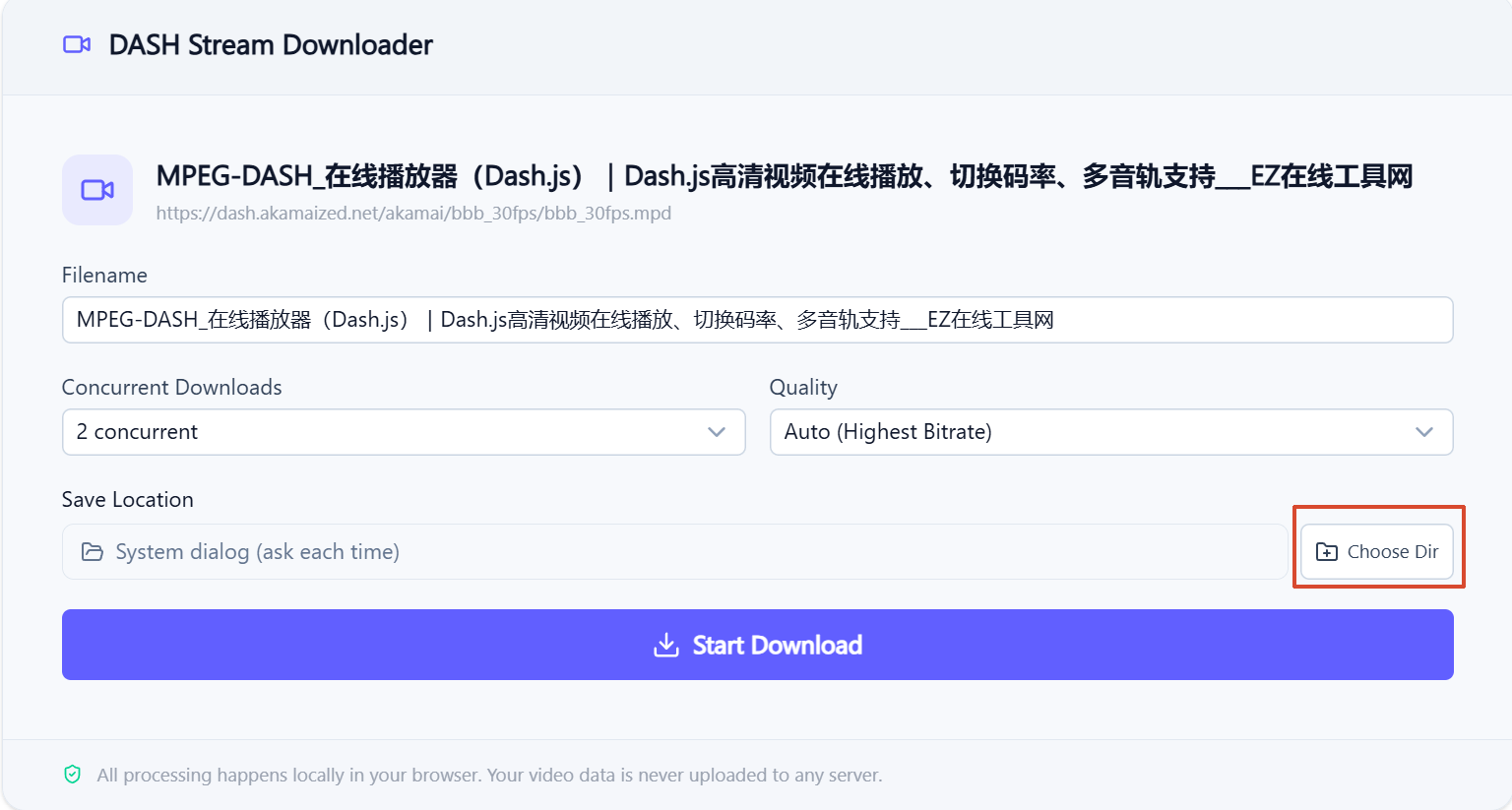
Technical Implementation:
- Use
window.showDirectoryPicker()to get directory handle - Request persistent permission via
handle.requestPermission({ mode: 'readwrite' }) - Directory name cached in
localStoragefor UI display - Permission status silently checked via
navigator.permissions.query()
Write Strategy Priority
Download engine selects file writing method by following priority:
| Priority | Strategy | Memory Usage | Applicable Conditions |
|---|---|---|---|
| 1 | File System Access API | Extremely low (streaming write) | Chrome 86+, Edge 86+ |
| 2 | StreamSaver.js | Extremely low (streaming write) | Requires Service Worker support |
| 3 | Blob download | Equal to file size | Fallback option, has 1.5GB limit |
Error Handling
Errors that may be encountered during download and how they're handled:
| Error Type | Cause | Handling Method |
|---|---|---|
| HTTP 403 | Resource requires authentication or Referer validation | Prompt user to check if URL is valid |
| HTTP 404 | Segment expired or URL incorrect | Prompt user to re-obtain stream address |
| CORS error | Cross-origin request rejected by server | Recommend using browser extension version |
| Network error | Connection interrupted or timeout | Auto-retry 3 times |
| Unsupported encryption | Encountered unsupported encryption method | Clearly indicate unable to process |
| DRM protection | Content DRM protected | Inform user content cannot be downloaded |
After Download Completion
Following operations provided after download completion:
- Copy path: Copy file save path to clipboard
- Download another: Reset state, prepare for next download
- Clear save directory: Remove directory authorization
Technical Limitations
Online tools have following limitations compared to extension version:
- Cross-origin restrictions: Browser same-origin policy may block downloading segments from certain CDNs. Extension version can bypass some restrictions via
webRequestpermissions - Referer validation: Some streaming servers require specific Referer headers, which online tools cannot customize
- Service Worker dependency: StreamSaver write strategy requires Service Worker support, and requires page to set correct COEP/COOP headers
- SharedArrayBuffer: FFmpeg WASM multi-threaded mode requires
SharedArrayBuffer, which requires page to setCross-Origin-Isolatedheader
FlowPick website has configured necessary security headers to support these features:
Cross-Origin-Opener-Policy: same-origin
Cross-Origin-Embedder-Policy: require-corp
Typical Use Cases
Scenario 1: Quick Download of Known Stream Address
Get M3U8 URL → Open /m3u8-downloader → Paste → Select quality → Download
Suitable for scenarios where stream address has been obtained via F12 developer tools. Refer to Video Platforms — Manual URL Retrieval.
Scenario 2: Temporary Device Download
Public computer → Open FlowPick website → Paste stream address → Download to USB drive
No software installation needed, suitable for environments like company computers, school computer labs, internet cafes where extensions cannot be installed.
Scenario 3: Batch Download Multiple Streams
Collect all M3U8 URLs → Download each one in online tool → Queue auto-managed
Suitable for scenarios needing to download multiple course videos or series videos. Refer to Online Courses Download.
Related Documentation
- Installation Guide — Browser extension installation method
- Usage Guide — Complete operation guide for extension and online tools
- Video Sniffing — Detection principles for HLS/DASH protocols
- Format Conversion — TS→MP4 remuxing and FFmpeg WASM
- Batch Download — Multi-resource queue management
- Privacy & Security — Local processing, zero data upload
- Download Engine Architecture — Concurrent download and write strategies
- Browser Compatibility — FSA/StreamSaver support status
- Video Platform Downloads — Stream address retrieval methods for various platforms
- Online Courses Download — Course video batch download
- Live Replay Saving — Large file streaming download
- Common Issues Troubleshooting — Diagnosis of CORS errors and other issues
- Known Issues — Known limitations of online tools
Search & Filter
URL search (fuzzy and regex), type and size filters in the FlowPick popup, and how to combine them to locate resources quickly.
Browser Compatibility
FlowPick feature support across different browsers, including API compatibility matrix, fallback strategies, and browser selection recommendations.