
FAQ
This document collects the most frequently asked questions during FlowPick usage. If your issue isn't listed here, please refer to Common Issues Troubleshooting or provide feedback via GitHub Issues.
Quick Navigation
| Category | Question Count | Jump To |
|---|---|---|
| Installation & Setup | 4 | Installation & Setup |
| Media Detection | 3 | Media Detection |
| Download-Related | 5 | Download-Related |
| Format Conversion | 3 | Format Conversion |
| Privacy & Security | 3 | Privacy & Security |
| Technical Questions | 3 | Technical Questions |
| Other Questions | 4 | Other Questions |
Installation & Setup
Is FlowPick free?
Yes, FlowPick is completely free with no paid features or subscription plans. The project code is open source on GitHub.
Why does the extension need "Read and change website data" permission?
FlowPick needs to monitor network requests to detect media resources on pages. This permission is only used for:
- Monitoring network requests from browser to identify video, audio, and image URLs
- Initiating download requests when user actively clicks download
FlowPick doesn't collect, upload, or share your browsing data.
Can I use it on Firefox?
Firefox extension version is under development. Currently you can use online tools on Firefox (/m3u8-downloader, /dash-downloader), but functionality limited by Firefox's support for File System Access API and SharedArrayBuffer.
How do I update to latest version?
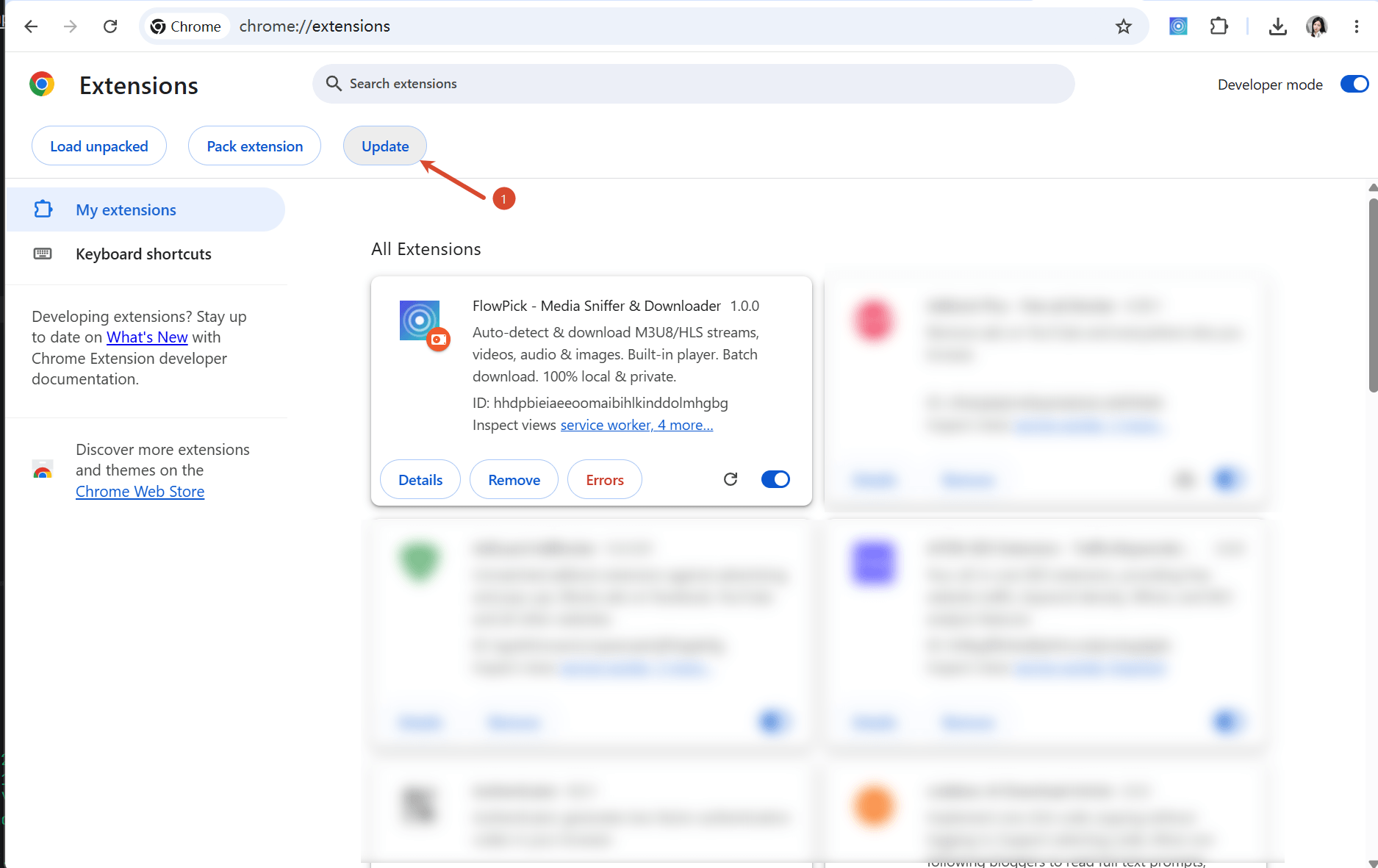
Chrome/Edge extensions auto-update. You can also manually check for updates:
- Open
chrome://extensions(Edge:edge://extensions) - Enable "Developer mode" in top-right corner
- Click "Update" button
Media Detection
Why can't video on page be detected?
Most common causes and solutions:
- Page hasn't loaded media yet: Play video for a few seconds first, then refresh page and reopen FlowPick
- Extension activated after page loaded: Refresh page so extension re-monitors network requests
- Website uses MSE dynamic loading: Some websites push data dynamically via Media Source Extensions; may not be detectable through regular network request monitoring
- Media in iframe: Media in cross-origin iframes may not be detectable
Too many files detected, how to filter?
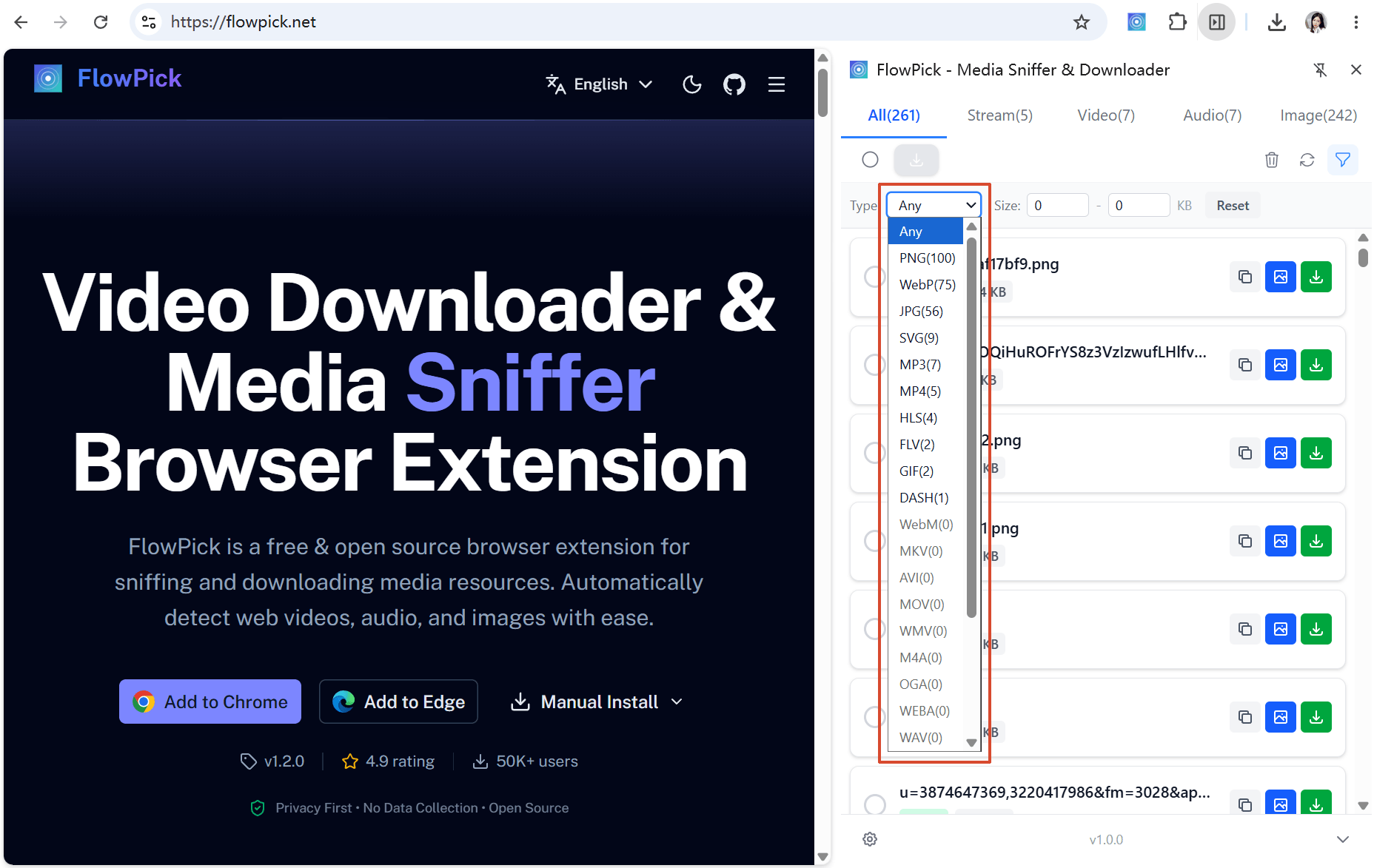
Use filtering features in FlowPick popup:
- Type filter: Switch between Video/Audio/Image tabs
- Size filter: Set minimum file size to exclude thumbnails and small icons
- Format filter: Filter by file extension (e.g., show only
.mp4)
Why does same video appear multiple times?
Streaming typically contains multiple quality versions (e.g., 720p, 1080p, 4K); each version displays as separate entry. Select desired quality to download. If using M3U8 stream with Master Playlist, FlowPick shows quality list for selection.
Download-Related
What to do about slow download speed?
Factors affecting download speed and optimization suggestions:
| Factor | Optimization Method |
|---|---|
| Concurrent thread count too low | Increase to 4-6 in settings |
| CDN throttling | Reduce concurrency to avoid triggering rate limiting |
| Insufficient network bandwidth | Close other bandwidth-consuming apps |
| Segment server far away | Cannot optimize; depends on streaming service provider |
Downloaded file won't play?
Troubleshoot with these steps:
- Check file size: If file significantly smaller than expected (e.g., only few KB), download incomplete
- Check format: Confirm player supports format (TS format requires VLC or PotPlayer)
- Check encryption: If encrypted stream key fetch fails, file cannot be decrypted
- Try remuxing: Convert TS to MP4 before playing
Can I download multiple files simultaneously?
Yes. Check multiple resources in popup and click "Download Selected"; they will download sequentially one by one.
Can I resume interrupted downloads?
Current version doesn't support resumable downloads. If download interrupted:
- Already downloaded segment data will be lost
- Need to restart download from beginning
- Recommend using stable network environment for large file downloads
Why No Resumable Downloads?
Resumable downloads require persisting downloaded segment data to disk and continuing from breakpoint on recovery. This faces two main challenges in browser environment:
- Storage limitations: Browser storage (IndexedDB) has quota limits; cannot reliably store GB-level segment data
- Segment URL expiration: Streaming segment URLs usually contain time-sensitive tokens; even short interruption causes token expiration, preventing remaining segments from downloading even if resumed
Where are downloaded files saved?
Depends on browser settings and selected save method:
- Chrome default: Browser's default download directory (usually "Downloads" folder)
- Select directory mode: Folder specified through directory picker
- Ask every time: Save dialog pops up each time you download
Format Conversion
What's the difference between TS and MP4?
| Feature | TS | MP4 |
|---|---|---|
| Full Name | MPEG Transport Stream | MPEG-4 Part 14 |
| Designed For | Streaming transmission | Local storage and playback |
| Playback Compatibility | Requires professional players like VLC/PotPlayer | Almost all players supported |
| File Size | Slightly larger (includes transport overhead) | Slightly smaller |
| Download Speed | Fast (no remuxing needed) | Slow (requires FFmpeg processing) |
Recommendation: If player supports TS format, selecting TS output skips remuxing step for faster downloads.
Why does remuxing take a long time?
FFmpeg runs as WebAssembly in browser; performance approximately 10-20% of native version. Influencing factors:
- File size: Larger files remux slower
- SharedArrayBuffer: Only single-thread operation when unavailable
- CPU performance: WASM execution speed depends on device CPU
What to do when remuxing fails?
Common causes and solutions:
- FFmpeg load failure: Refresh page and retry, check network connection
- Insufficient memory: Close other tabs, reduce concurrency
- Source file corrupted: Some segments downloaded incompletely, try re-downloading
- Unsupported codec: FlowPick only does container conversion; unsupported codec formats cannot be processed
Privacy & Security
Does FlowPick collect my data?
No. All processing by FlowPick completes locally in your browser:
- Media detection happens inside extension; no data uploaded
- File downloads directly from source server to your disk
- No backend servers, no user account system
- Google Analytics used only for anonymous visit statistics (can be blocked by ad blockers)
Are there copyright issues with downloaded content?
FlowPick is a tool that neither judges nor restricts what you download. Please follow these principles:
- Only download content you have right to access and use
- Comply with website terms of service
- Use downloaded content for personal fair use only
- Don't use downloaded content for commercial purposes or redistribution
Are online tools safe?
All processing for online tools (/m3u8-downloader, /dash-downloader) also completes locally in browser:
- Pasted URLs aren't sent to any server
- Downloaded data transfers directly from source server to your disk
- FFmpeg runs in browser; files not uploaded
Technical Questions
What is SharedArrayBuffer, why is it needed?
SharedArrayBuffer is a JavaScript object allowing multiple threads to share memory. FFmpeg WASM uses it to implement multithreaded parallel processing, significantly improving remuxing speed.
For security reasons (Spectre vulnerability mitigation), browsers require website to set specific HTTP response headers to use SharedArrayBuffer. If headers aren't set, FFmpeg automatically degrades to single-thread mode.
Why do online tools require pasting URL instead of auto-detecting?
Browser extensions can monitor network requests, but ordinary web pages restricted by same-origin policy cannot access other tabs' network request data. Online tools run as ordinary web pages, requiring you to manually provide streaming URL.
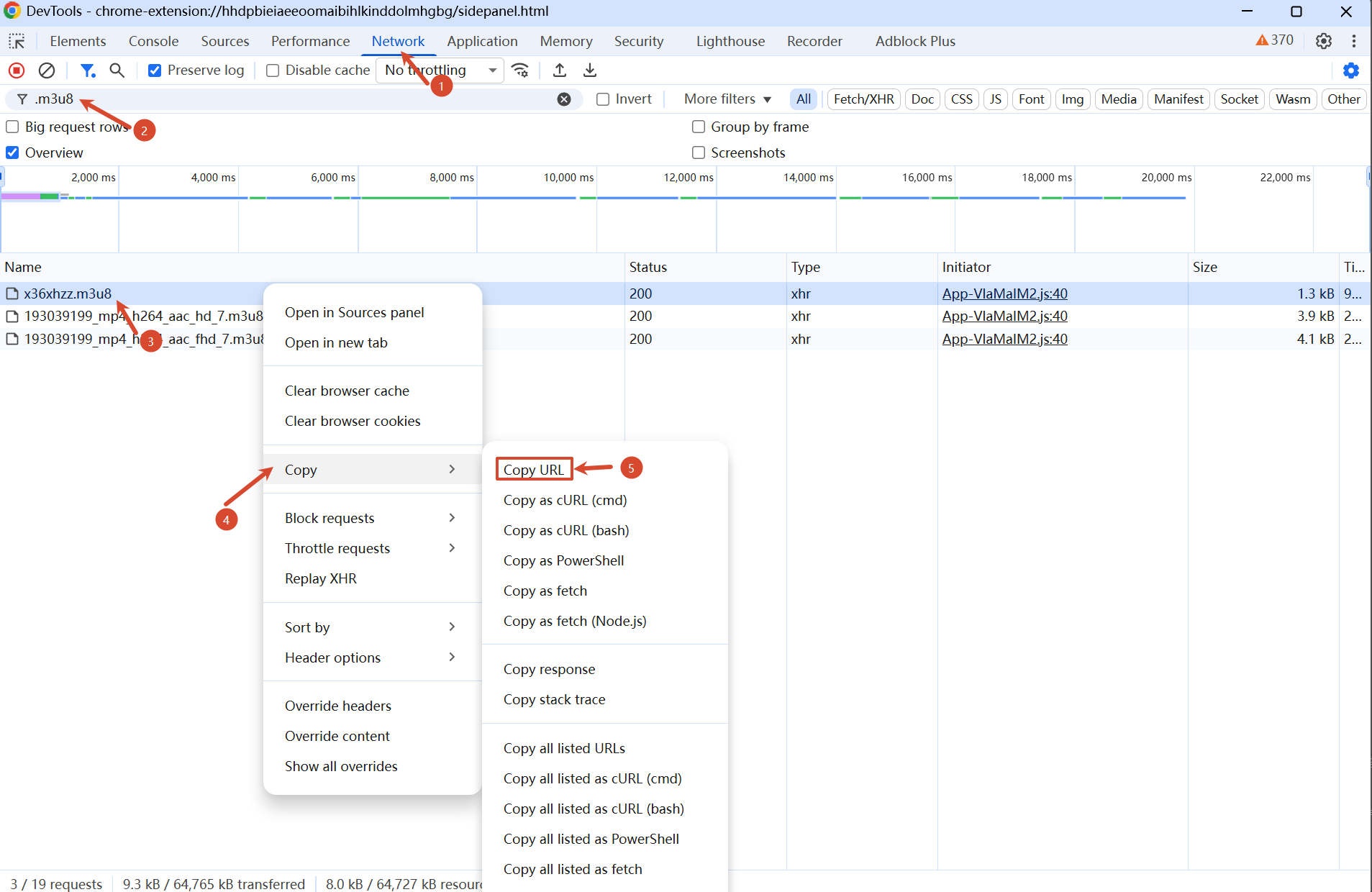
How to Get Streaming URL?
- Press
F12to open Developer Tools - Switch to Network panel
- Type
m3u8ormpdin filter box - Play video, observe appearing requests
- Right-click M3U8/MPD request → Copy → Copy link address
What's the difference between extension version and online tools?
| Feature | Extension Version | Online Tools |
|---|---|---|
| Auto-detect media | Supported | Not Supported |
| CORS restrictions | Not restricted | Restricted |
| Installation required | Need install extension | No installation needed |
| Ease of use | One-click detect & download | Manually obtain URL needed |
| Use case | Daily usage | Temporary use, environments where extension can't be installed |
Other Questions
Is this project open source?
Yes, FlowPick is open source on GitHub. You can view source code, submit issues, or contribute code.
How do I report bugs?
Submit bug reports via GitHub Issues, please include:
- Browser type and version
- Operating system
- Issue description and reproduction steps
- Console error log (F12 → Console)
- Relevant streaming URL (if publicly accessible)
How do I request new features?
Submit feature requests via GitHub Issues, please describe:
- Feature you want implemented
- Use case
- Expected behavior
Can I self-deploy the online tools?
Yes. FlowPick is a Nuxt application; you can clone repository and build/deploy yourself. Note:
- Deployment environment must configure COEP/COOP response headers to enable FFmpeg multithreading
- StreamSaver.js's
mitm.htmland Service Worker must be correctly deployed - Recommend using Cloudflare Pages or Vercel or similar platforms supporting custom response headers
Related Documentation
- Common Issues Troubleshooting — Diagnostic steps and solutions organized by symptom
- Known Limitations — Current version technical limitations and edge cases
- Installation Guide — Extension installation and activation
- Configuration Reference — Concurrency, filter, and other settings
- Video Sniffing — HLS/DASH manifest parsing and encryption detection
- Image Download — Image detection and download features
- Format Conversion — FFmpeg WASM engine and output formats
- Batch Download — Queue scheduling and concurrency control
- Download Engine Architecture — Complete technical architecture of download engine
- Browser Compatibility — Browser API support and degradation strategies
- Online Tools — Online tool usage and limitations
- Privacy & Security — Permission explanation and privacy protection
- Contributing Guide — How to report bugs and contribute code
- Online Course Download — Online course download scenarios
- Image Gallery Batch Download — Batch image download scenarios